The Complete Guide to Cycling in Late-Summer Heat Without Blowing Up
Quick Answer: In heat, a large share of your cardiac output is redirected to the skin for cooling, which reduces the blood available to working muscle and drives heart rate up at any given power. Expect roughly 5-10 bpm of cardiac drift per 10 degrees Fahrenheit above your comfortable range. The fixes, in order of impact: ride earlier, pace by power or perceived effort rather than heart rate, pre-cool, drink to a schedule with sodium, dress for evaporation, adjust route for shade and wind, and shorten the hard efforts.
Your fitness did not fall off a cliff in August. Your cooling system started charging rent, and it is billing your legs.
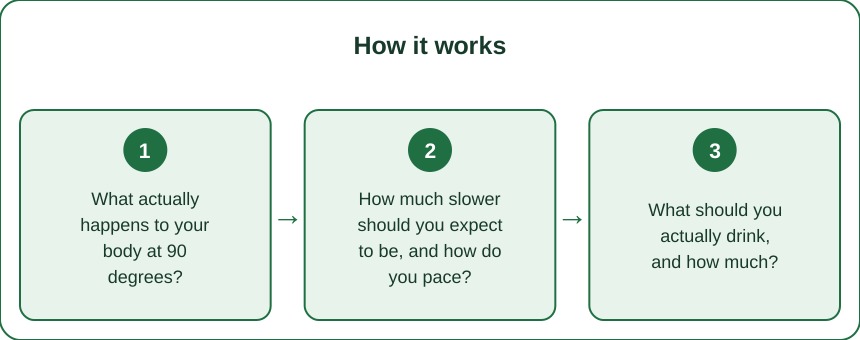
What actually happens to your body at 90 degrees?
The core problem is that blood has two jobs and cannot do both at once.
Working muscle needs blood for oxygen delivery. Skin needs blood to carry heat to the surface where sweat can evaporate it. In cool conditions these demands coexist comfortably. As ambient temperature climbs, skin blood flow increases substantially, and that volume comes out of the same finite cardiac output.
The visible result is cardiac drift: your heart rate rises steadily at constant power. Not because you are working harder, but because stroke volume drops as plasma volume declines through sweating, and heart rate compensates to maintain output.
At the same time, core temperature rising toward 39C begins to reduce central drive independent of anything happening in the legs. This is the phenomenon where you feel fine cardiovascularly and simply cannot make the pedals turn as hard. It is not weakness and it is not mental.
There is also a real and underappreciated cognitive component. Decision quality, line choice, and group riding awareness all degrade with heat strain, which matters for safety on descents and in traffic well before it matters for your average speed.
And the sweat rate itself is highly individual, commonly ranging from 0.5 to 2.0 liters per hour depending on size, fitness, and acclimation. Two riders on the same road can have a fourfold difference in fluid requirement, which is why generic hydration advice fails so many people.
How much slower should you expect to be, and how do you pace?
Plan for a 3-8 percent reduction in sustainable power in genuinely hot conditions, more if you are not heat-acclimated, and considerably more if humidity is high enough to impair evaporation.
Humidity is the variable people underweight. Sweat only cools you when it evaporates. At high humidity, sweat runs off the body without a phase change and provides almost no cooling while still costing you the fluid. Ninety degrees at 30 percent humidity and eighty-five degrees at 85 percent humidity are not comparable, and the second one is harder.
For pacing, the single most important change is this: stop pacing by heart rate in the heat. Heart rate is elevated by thermoregulation, so holding your normal heart rate zone means producing meaningfully less power than that zone represents in cool conditions. Riders who chase their usual numbers on a hot day systematically overreach early and fade badly.
Use power if you have it, accepting that the numbers will be lower and that this is correct rather than a sign of lost fitness. Use perceived effort if you do not, and calibrate it against breathing rather than leg burn.
For a long hot ride, start deliberately slower than feels right for the first thirty minutes. Core temperature is cumulative and slow to shed, so the effort you make in the first hour determines your ceiling in the third. Riders who go out easy in heat routinely finish faster than riders who go out at target and hold on.
Acclimation is also real and fast. Roughly 10 to 14 days of regular heat exposure produces measurable adaptation: increased plasma volume, earlier sweat onset, and lower sodium concentration in sweat. Someone three weeks into a hot spell is a genuinely different rider from someone on the first hot day.
What should you actually drink, and how much?
The workable default is 500-750 ml per hour with sodium, adjusted by your own sweat rate rather than a rule.
Find your rate once. Weigh yourself naked before a one-hour ride, weigh yourself after, and add back the weight of anything you drank. Each kilogram lost is approximately one liter of sweat. Doing this on one hot day and one mild day tells you more than any general guidance can.
Sodium matters more as duration extends. Sweat sodium concentration varies widely, typically 300 to 1500 mg per liter, and unlike fluid it is not replaced by drinking plain water. On rides over about ninety minutes in heat, plain water alone can dilute plasma sodium and produce the headache, nausea, and heavy-legged feeling that many riders misattribute to dehydration and treat by drinking more water, which makes it worse.
A practical structure: one bottle plain water, one bottle with electrolyte mix, and drink to a schedule rather than to thirst. Thirst lags actual need by a meaningful margin during exercise, and once you are behind in heat you cannot catch up on the bike. Gastric emptying is limited to roughly a liter per hour under the best conditions and less when you are hot.
Start hydrated. Pre-loading 400-600 ml in the hour before the ride is far easier than replacing that same volume mid-ride, and it costs you nothing but a bathroom stop.
Cold fluids are measurably better than warm ones, not only for palatability but because ingesting cold liquid provides a small genuine heat sink. Insulated bottles are one of the highest return-per-dollar purchases in hot-weather cycling.
Does pre-cooling actually work, or is it a pro-team gimmick?
It works, and the effect is larger than most amateurs expect.
Pre-cooling lowers your starting core temperature, which buys you time before you reach the threshold where performance degrades. Since core temperature rise is cumulative over a ride, starting half a degree lower effectively extends your usable duration.
The practical amateur versions: a cold shower in the 30 minutes before departure, an ice slurry or very cold drink consumed in the last 15 minutes, and avoiding standing around in the sun before you start. A rider who spends 20 minutes chatting in a parking lot in direct sun has already spent part of their heat budget before turning a pedal.
During the ride, cooling the skin has both a real and a perceptual effect, and both are useful. Pouring water over your head, forearms, and the back of your neck increases evaporative cooling directly. It also reduces perceived exertion, which changes pacing decisions in your favor.
Carry one bottle you are willing to pour rather than drink. On a genuinely hot day this is not a waste of a bottle; it is the second most effective tool you have after riding earlier.
Ice in a sock or a jersey pocket at the back of the neck is a cheap approximation of what pro teams do with ice vests, and it works reasonably well for the first twenty minutes.
What should you wear, and how should the route change?
Clothing: prioritize evaporation over coverage
Prioritize evaporation over coverage, but do not confuse less fabric with more cooling.
A lightweight, light-colored, loose-weave jersey with full coverage often outperforms a bare or minimal top in direct sun, because it blocks radiant solar load while still allowing evaporation. Skin in direct sun absorbs heat continuously; skin under an open-weave fabric does not, and the fabric wicks sweat into a larger surface area where it evaporates faster.
Color does matter, though less than fit and fabric. Light colors reflect more solar radiation. The difference is modest but free.
Fit is where the real gains are. A jersey that clings to wet skin at every point has less evaporative surface than one with a small amount of air movement between fabric and skin. This is why the very tight aero jersey that is fast in cool conditions can be a liability on a slow hot climb where airflow is minimal.
Other details that add up: a light-colored helmet with genuine vent flow, sunglasses that do not trap heat against the face, and lightweight socks. Overheated feet are a common and easily fixed complaint that people simply endure.
Sunscreen is a performance item, not just a health item. Sunburned skin has impaired thermoregulation and increased blood flow demand for days afterward, which is why a bad burn on Saturday makes Sunday’s ride disproportionately hard.
Route and structure: three changes that beat any equipment choice
Three structural changes matter more than any equipment choice.
Ride earlier. This is the single largest lever and the one people resist most. On a typical late-summer day, a 6:30am start can be fifteen to twenty degrees cooler than a 2pm start, with lower solar angle and often calmer air. No hydration strategy competes with simply removing the heat.
Restructure where the effort goes. Climbs in heat are the worst case: high power output, low airflow, and often full sun. If your route has a choice, take the hard efforts early while core temperature is low, and put the climbing before rather than after the midpoint. On a hot day, a route with the climbing at hour three is a fundamentally harder route than the same climbing at hour one.
Plan water, not just distance. Know where the refills are, and treat a hot ride as a series of segments between water stops rather than a continuous distance. This changes your decision-making when things go wrong, because a rider who knows the next tap is six miles away makes better choices than one who is guessing.
Also reconsider group dynamics. Drafting reduces airflow across your body substantially, so sitting in a tight bunch in heat is cooler in the legs and hotter in the core. On very hot days, riding slightly off the wheel is a reasonable trade.
And shorten the plan without guilt. Two hours ridden well in heat produces better adaptation than four hours of survival, and the four-hour version compromises the next three days of training.
When is it heat exhaustion and not just a hard day?
This is the section that matters most, because the early signs are easy to rationalize.
Normal hot-ride discomfort looks like: elevated heart rate, reduced power, heavy legs, a strong desire to stop, and rapid recovery once you are in shade with cold fluid.
Heat exhaustion looks different in specific ways. Stopping sweating while still hot is a serious sign. So is skin that has gone pale and clammy rather than flushed, nausea that does not resolve with slowing down, a headache that intensifies, dizziness on standing, and confusion or difficulty following a conversation.
Goosebumps or chills in heat are a genuine red flag and are often the last clear warning before things escalate.
If any of these appear: stop, get out of the sun, get horizontal with legs elevated, apply cold water to the neck, armpits, and groin, and drink cold fluid with sodium if you can keep it down. Do not ride home to save time. Heat illness progresses, and the transition from heat exhaustion to heat stroke can be fast.
Call for help if confusion, vomiting, or an inability to cool down within about 20 minutes is present. Heat stroke is a medical emergency and the outcome depends heavily on how quickly core temperature comes down.
This is general information, not medical advice. Riders on medications affecting hydration or heart rate, and those with cardiovascular conditions, should get individual guidance before training in significant heat.
FAQ: Hot Weather Cycling Questions, Answered
Why do I feel worse on the ride home when it is cooler?
Core temperature and fluid deficit are cumulative and lag ambient conditions. You are paying for hour two during hour three, and a slightly lower air temperature does not undo accumulated strain.
Is it better to ride indoors on very hot days?
Only with real airflow. An indoor trainer without a strong fan is frequently hotter than outdoors, because you lose the 20 mph of airflow that riding provides. A large fan is not optional equipment for indoor summer training.
How long does heat acclimation last if I stop?
It decays within roughly one to two weeks without exposure, though it returns faster the second time. This is why the first hot day after a cool week feels disproportionately bad even in the middle of summer.
TL;DR:
- Heat redirects blood to the skin, so heart rate rises and sustainable power drops 3-8 percent or more
- Pace by power or perceived effort, never by heart rate, and start the first 30 minutes deliberately easy
- Drink 500-750 ml per hour with sodium, pre-load before the ride, and carry one bottle to pour over yourself
- Ride earlier, put the climbing early, and treat stopped sweating or chills as a reason to stop immediately
Riding well in heat is mostly a scheduling and pacing problem wearing a hydration costume. Move the start time, ease off the first half hour, and the twenty watts come back.
Keep Reading
This article is for general informational and styling purposes only. Fit, sizing, and product availability may vary — check current details before purchasing.