Complete Guide: Why Tyre Pressure Changes Your Ride More Than Wheels Do
Quick Answer: Tyre pressure decides how much energy your ride loses to road vibration, and on real road surfaces that loss is far larger than the aerodynamic differences between wheelsets. Most riders run 15 to 25 psi too high because they follow the sidewall maximum rather than their own weight and tyre width. Getting pressure right is free, takes one minute, and is felt on every single ride.
The new wheels arrived. They are beautiful. The ride felt about the same.
Meanwhile the club rider who dropped you on the rough section is on ten-year-old aluminium rims and 28mm tyres at 65 psi.
There is no mystery here, and it is entirely fixable this afternoon.
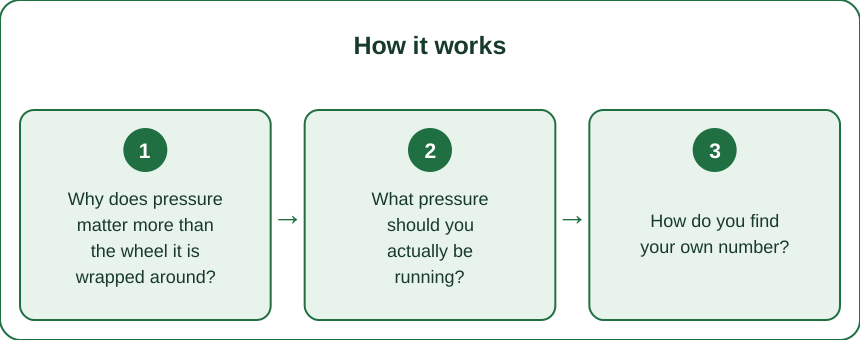
Why does pressure matter more than the wheel it is wrapped around?
Because road surfaces are not smooth, and rolling resistance on a real road behaves nothing like it does on a laboratory drum.
On a perfectly smooth surface, higher pressure genuinely rolls faster. A harder tyre deforms less, and less deformation means less energy lost to the flexing of the casing. This is the physics that produced decades of advice to pump tyres as hard as they would go.
On an actual road, a second and larger loss appears. Every bump the tyre cannot absorb is transmitted into you — into the bike frame, the saddle, your hands, and eventually into the soft tissue of your body, which damps the vibration and turns it into heat. That energy is gone. It came out of your legs.
This is called suspension loss, and on typical asphalt it becomes the dominant term above a certain pressure. Plot rolling resistance against pressure on a real road and it does not keep falling — it falls, reaches a minimum, and then rises again. That minimum is what you are looking for, and it is called the breakpoint pressure.
Independent testing consistently places that breakpoint well below what most riders run. On reasonable asphalt, a 70kg rider on 28mm tyres is often best served somewhere in the 60 to 70 psi range — and will frequently be found running 95.
For comparison, the aerodynamic difference between a good mid-depth wheelset and a basic one is real but modest — typically worth a handful of watts at 30km/h. Running 25 psi over your breakpoint on a rough road can cost considerably more than that, and it costs it whether you are going fast or slow.
Which is why the wheels felt the same. They probably were slightly better. The tyres underneath them were undoing it.
What pressure should you actually be running?
It depends on four things, and only one of them is printed on the tyre.
Your total system weight. This means you, the bike, and everything on it — not just body weight. A 65kg rider on a 9kg bike with 2kg of kit is a 76kg system, and that is the number that matters.
Your tyre width, measured rather than labelled. A tyre marked 28mm on a modern wide rim frequently measures 30 or 31mm, and width changes the correct pressure substantially. Measure with callipers, or with a ruler against the inflated tyre.
Your weight distribution. Most road riders carry roughly 40% of their weight on the front wheel and 60% on the rear. This is why the two tyres should not be at the same pressure — the rear typically wants 5 to 10 psi more than the front, and almost nobody does this.
The surface you actually ride. Smooth new asphalt supports higher pressure; chip seal, broken tarmac, and gravel push the breakpoint sharply downward.
A reasonable starting point for tubeless or tubed clinchers on road:
- 28mm tyre, 75kg system: around 65 psi front, 72 psi rear
- 32mm tyre, 75kg system: around 50 psi front, 57 psi rear
- 25mm tyre, 75kg system: around 80 psi front, 87 psi rear
- Add or subtract roughly 1 psi per kg of system weight away from 75kg
These are starting points, not answers. The answer comes from riding them, which is the next section.
How do you find your own number?
By testing on one familiar stretch of road, changing one thing at a time.
Pick a route you know well — ideally 10 to 20 minutes with a mix of surfaces, and preferably one you can ride in similar conditions repeatedly.
Start high and come down. Begin at whatever you currently run. Ride the loop. Then drop 5 psi from both tyres and ride it again.
Pay attention to three things: how much road buzz reaches your hands, how the bike behaves on the rough section, and whether you can hold a line comfortably through corners.
Keep dropping in 5 psi steps until one of two things happens. Either the bike starts to feel vague or squirmy in corners, or you feel the rim on a bump. Then come back up 5 psi. That is your pressure.
Most riders are surprised by how far down it goes and by how much faster the bike feels on rough surfaces at the lower number — the sensation of speed from a hard tyre is vibration, not velocity.
Two safety limits that are not negotiable:
- Never go below your rim manufacturer’s minimum, particularly with hookless rims, which have specific and strict limits
- Watch for rim strikes. If you bottom out on a bump you have found the floor, and repeated strikes damage both rim and tyre
Write the final numbers on a piece of tape on your top tube. It sounds unnecessary and it means you actually run them, rather than defaulting to whatever the pump reads when you are in a hurry.
How much does pressure change day to day?
More than most people check for, which is the practical reason this gets neglected.
A standard butyl inner tube loses roughly 1 to 2 psi per day. A latex tube can lose 5 to 10 psi overnight. Tubeless setups sit somewhere in between, depending on sealant and how well the tyre seated.
Which means a bike pumped on Sunday and ridden on Saturday is running a completely different setup, and it is why some rides mysteriously feel sluggish and harsh at the same time.
Temperature moves it too. Pressure changes by roughly 2% for every 10°C, so a tyre inflated in a warm house and ridden on a cold autumn morning arrives at the road several psi lower than you set it. This is a genuine seasonal effect and it is why the same pressure that felt perfect in July can feel vague in October.
Long descents heat the rim and raise pressure, particularly with rim brakes, which is a real consideration on mountain days.
The practical routine that solves all of it:
- Check before every ride, not weekly — it takes 30 seconds with a floor pump
- Use a gauge you trust. Cheap pump gauges are routinely off by 10 psi or more, and a separate digital gauge costs little and settles the question
- Set for the temperature you will ride in, not the temperature of the garage
- Recheck the number seasonally, since the road surface changes with weather too
The gauge point matters more than it sounds. If your pump reads 10 psi high, every careful calculation above is wrong by 10 psi, and you will conclude the whole approach does not work.
What about wider tyres — does the same logic apply?
It is the same logic, and it is the reason the whole sport moved to wider tyres in the first place.
A wider tyre at a lower pressure has a contact patch of roughly the same area, shaped differently — shorter and wider rather than long and narrow. A shorter contact patch means less casing deformation per revolution, which is why a 32mm tyre at 50 psi can roll as well as or better than a 25mm at 90.
And the wider tyre absorbs road texture rather than transmitting it, which cuts suspension loss substantially. The combination is why 28 to 32mm is now standard on road bikes that used to run 23mm.
Comfort improvements are not a separate benefit — they are the same benefit. Vibration that does not reach your body is energy that stayed in the system, and it is also fatigue that does not accumulate over four hours.
The trade-offs are real but small:
- Slightly more aerodynamic drag at the front of the tyre, which matters above roughly 35km/h and is largely offset below it
- A little more weight, on the order of 30 to 60g per tyre, which affects acceleration marginally and steady speed almost not at all
- Frame and fork clearance, which is the actual limiting factor for most riders — check yours before buying, allowing 4mm of clearance around an inflated tyre
If your frame takes them, wider tyres run at the right pressure are the single best value upgrade in cycling, and they cost a fraction of a wheelset.
What does this look like as the seasons change?
Autumn is where the wrong pressure hurts most, and where the correction pays most.
Road surfaces deteriorate as the weather turns. Water gets into cracks, debris accumulates, and the smooth summer surface you tuned your pressure on is not the surface you are riding in October.
Cold air means lower pressure than you set indoors — around 2% per 10°C, so a 15°C drop from house to road takes about 2 psi off a 70 psi tyre. Not enormous on its own, and it compounds with everything else.
Wet roads change the priority. Lower pressure increases the contact patch and improves wet grip, which matters more than a marginal rolling gain when you are cornering on damp leaves. Dropping 5 psi from your dry-road number is a reasonable wet-weather default.
Debris rises, so puncture risk rises. This is an argument for tubeless or for a more robust tyre in autumn, not for higher pressure — high pressure increases pinch flats and does very little against sharp objects, which is the opposite of what most people assume.
A sensible seasonal routine:
- Re-run the pressure test once when the surfaces change, usually early autumn
- Keep 5 psi in reserve as a wet-weather adjustment you make at the door
- Inspect tyres weekly for embedded grit, which finds its way through over a wet month
- Top up sealant if running tubeless, since it dries out and the timing of that tends to coincide with the season you most need it
FAQ: Tyre Pressure Questions, Answered
What if the sidewall says a minimum higher than my calculated pressure?
Follow the sidewall and the rim manufacturer, always. Tyre and rim minimums exist for safety, particularly on hookless rims where a tyre can unseat at low pressure. If your calculated ideal is below the stated minimum, you are on too narrow a tyre for your weight — the fix is a wider tyre, not a lower pressure than the manufacturer allows.
Should my front and rear really be different?
Yes, and the gap is worth having. Your rear wheel carries around 60% of the load, so it needs more pressure to achieve the same tyre deflection. Running them equal means one of them is wrong. 5 to 10 psi more in the rear is a good default, and you can feel the difference in front-end comfort immediately.
Does any of this matter if I ride casually?
Arguably more, not less. Comfort, grip, and puncture resistance all improve at the right pressure, and those matter to a casual rider considerably more than a few watts do. An overinflated tyre is harsh, skittish in the wet, and more prone to pinch flats — which is the whole experience of riding, not just the speed of it.
How do I know if I am too low rather than too high?
Three signs. The bike feels vague or wallowy when you push into a corner, the tyre visibly squirms under hard pedalling, or you feel the rim contacting on bumps. Any of those means come up 5 psi. Note that a slightly soft-feeling tyre that handles precisely is not too low — the feel of firmness and the fact of speed are different things, which is the whole point.
Is a digital gauge worth buying?
For about the price of a bidon, yes. Floor pump gauges are commonly inaccurate by 10 psi and drift over time, which makes careful pressure setting meaningless. A separate digital gauge is the cheapest accuracy you can buy in cycling and it also tells you how fast your tubes are actually losing air, which is useful in itself.
TL;DR:
- Real roads add suspension loss, so rolling resistance falls with pressure to a breakpoint and then rises again.
- Most riders run 15 to 25 psi above that breakpoint, which costs more than the wheels they bought to fix it.
- Set pressure by total system weight, measured tyre width, front/rear distribution, and surface — not by the sidewall.
- Rear tyres want 5 to 10 psi more than front; almost nobody does this and it is free comfort.
- Test on one familiar loop, dropping 5 psi at a time until handling goes vague, then come back up 5.
- Butyl tubes lose 1 to 2 psi a day, latex far more, and pressure drops about 2% per 10°C — check before every ride.
- Wider tyres at lower pressure are the best value upgrade in cycling if your frame has clearance.
Buy a gauge, spend one ride finding your number, write it on your top tube. It will do more for your riding than the next component you were considering.
Keep Reading
This article is for general informational and styling purposes only. Fit, sizing, and product availability may vary — check current details before purchasing.