Perfect Your Indoor Cycling Form to Ride Harder
Quick Answer: Proper cycling form starts with saddle height — your knee should have a slight bend (about 25–35 degrees) at the bottom of the pedal stroke. Then set handlebars so your back stays neutral without overreaching, keep your core engaged, relax your grip and shoulders, and drive smooth circles rather than stomping down. Fix the setup first; posture problems usually trace back to it.
You can pour everything into an indoor cycling class and still short-change yourself if your form is off.
The frustrating part is that most “form problems” aren’t form problems at all — they’re a saddle two inches too low. Fix the bike, and the posture mostly fixes itself.
Why Does Cycling Form Matter So Much?
Power transfer. Good position lets force travel from your legs into the pedals instead of leaking into a wobbling torso or a rounded back. Two riders working equally hard can produce meaningfully different output.
Injury prevention. Poor setup is the leading cause of knee, lower back and neck complaints in indoor cycling. Not the intensity — the position.
Sustainability. Uncomfortable riders don’t come back. Every “I tried spin and hated it” story has a bike setup somewhere in it.
How Do You Set Your Saddle Height?
This is the single adjustment that fixes most rider discomfort.
The rule: at the bottom of the pedal stroke, your knee should have a slight bend — roughly 25–35 degrees. Not locked straight, not deeply bent.
The quick method: stand beside the bike and set the saddle level with your hip bone. That gets you within an inch, and then fine-tune from there.
What too low looks like: knees deeply bent throughout, pain at the front of the knee, quads burning out fast, and a feeling of being cramped. This is the most common error by a wide margin.
What too high looks like: hips rocking side to side at the bottom of each stroke, pain behind the knee, and toes pointing down to reach.
Saddle fore-and-aft matters too. With pedals level (3 and 9 o’clock), your forward knee should sit roughly over the pedal spindle. Too far back overloads the knee; too far forward closes your hip angle.
Where Should the Handlebars Be?
Height: high enough that your back stays neutral and your neck relaxed. Beginners should start with bars level with or slightly above the saddle. Lower bars are more aerodynamic and more aggressive — earn that position over months, don’t start there.
Reach: you should be able to hold the bars with a slight elbow bend and relaxed shoulders. If you’re stretched out, you’ll round your spine to compensate, and after 45 minutes that’s a back complaint.
A useful check: at your normal riding position, can you take one hand off the bars without shifting your weight? If not, you’re leaning on the bars more than you should be.

What Does Good Riding Posture Look Like?
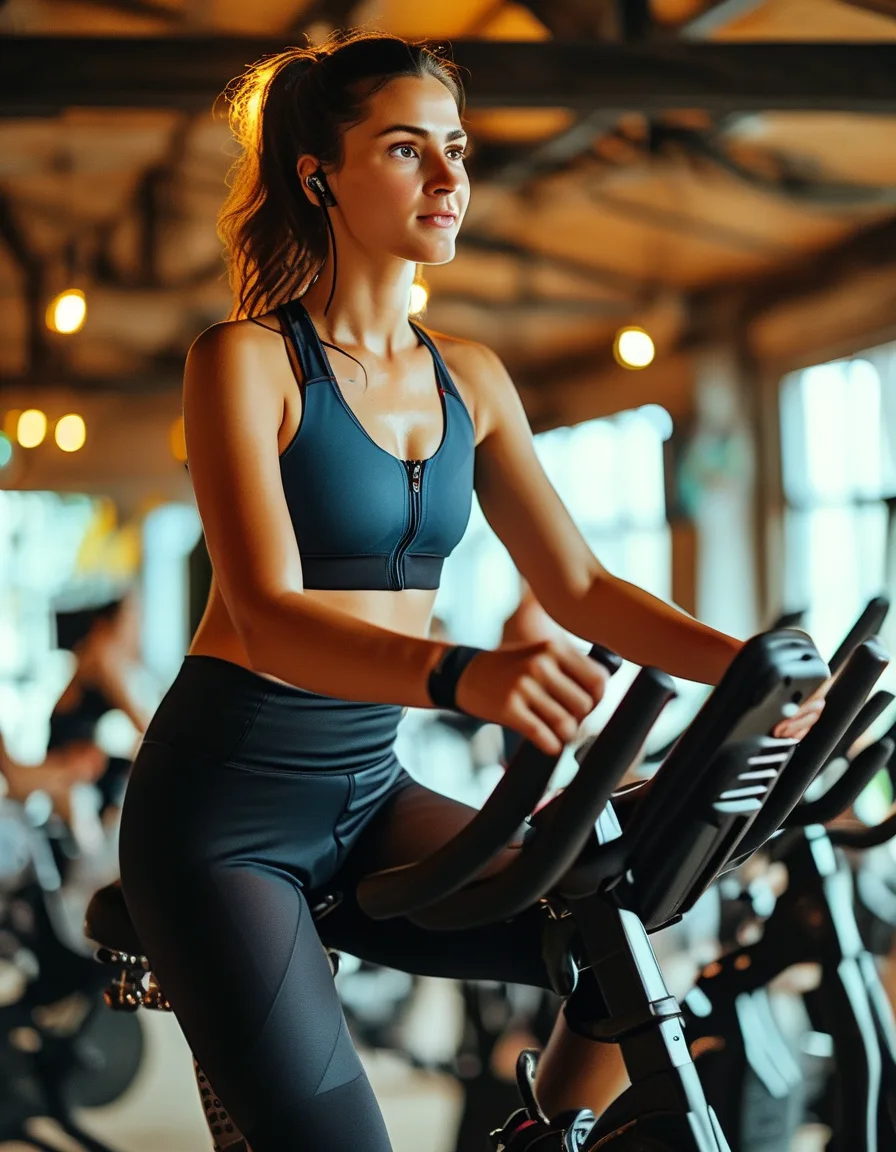
- Core engaged, lightly. Brace as if bracing for a light poke — enough to stabilize your pelvis, not a maximal squeeze. Your core, not your arms, should support your upper body.
- Relaxed grip. Hold the bars like you’re holding a bird you don’t want to crush. A white-knuckle grip creates shoulder and neck tension within minutes.
- Shoulders down and back, away from your ears. Check this every few minutes; it creeps.
- Elbows soft, slightly bent, tucked in rather than flared.
- Eyes forward, not down at the flywheel. Looking down rounds your upper back.
- Hips stable. Rocking side to side means the saddle is too high or you’re overreaching resistance.
- Pedal in circles. Push down, pull back at the bottom, ease up over the top. Stomping down only uses about half the stroke.
- Feet secure. Clipped in, or shoes properly caged and tightened.
5 Mistakes Everyone Makes
- Saddle too low. The default setting on most bikes is too low for most riders, and low feels safer, so nobody raises it. It’s the leading cause of knee pain.
- Death-gripping the bars. Creates neck and shoulder tension and puts weight where it doesn’t belong.
- Riding with no resistance at high cadence. Bouncing in the saddle at 130 rpm with nothing to push against isn’t training, and it’s hard on your hips. There should always be some tension.
- Rounding the back to reach the bars. The third mistake gets blamed for the most injuries, but this one causes the most persistent lower back complaints.
- Never writing your settings down. Take a photo of your saddle height, fore-aft and bar numbers once. Setup takes fifteen seconds forever after.
How Do You Check Your Form Mid-Ride?
Run a quick scan every ten minutes:
- Shoulders — dropped, or crept up toward my ears?
- Grip — relaxed, or clenched?
- Hips — stable, or rocking?
- Weight — supported by my core, or leaning on my hands?
- Stroke — circular, or stomping?
If anything actually hurts, stop and adjust rather than pushing through. Discomfort in a new position is normal for the first couple of rides; sharp pain is information.
FAQ
How do you know if your saddle is too high?
Your hips rock side to side at the bottom of the stroke, you feel pain behind the knee, or you have to point your toes down to reach the pedal. Lower it in small increments — a quarter inch at a time.
Why does my neck hurt during indoor cycling?
Usually bars set too low or too far away, which forces you to crane upward to look forward, or a tight grip that transfers tension up through the shoulders. Raise the bars and loosen the grip first.
Should you sit or stand more in a class?
Sitting is where most training effect lives. Standing sections are fine for variety and climbs, but they should be done with real resistance — standing on a light flywheel just bounces. If your legs are tired, stay seated and lower resistance rather than standing to escape.
Is saddle soreness normal for beginners?
Yes, for the first few rides, and it settles as your body adapts. Padded cycling shorts help substantially. Soreness that persists beyond a few weeks, or numbness of any kind, means the saddle position needs adjusting.
TL;DR:
- Saddle height first: 25–35 degree knee bend at the bottom, or level with your hip bone as a starting point.
- Too low is the most common error and the main cause of front-of-knee pain.
- Knee over the pedal spindle with cranks level sets the fore-aft position.
- Bars high enough for a neutral back, close enough that you’re not overreaching.
- Core engaged, grip relaxed, shoulders down, eyes forward, hips stable.
- Pedal in circles — push down, pull back, ease over the top.
- Always ride with some resistance; photograph your settings once and reuse them.
Keep Reading
This article is for general informational and styling purposes only. Fit, sizing, and product availability may vary — check current details before purchasing.