Why One Side of Your Body Does More Work on the Bike Than the Other
Quick Answer: Left-right asymmetry in cycling is near-universal — power meter data commonly shows imbalances in the range of 45/55, and small differences are entirely normal. It becomes a problem when the difference is large, when it grows with fatigue, or when it is being caused by something correctable: leg length difference, saddle height, cleat position, a hip or ankle restriction, or a habit built around an old injury. The reason it matters is that the stronger side does more work per revolution, which loads its tissues more, and cycling repeats that loading roughly 5,000 times an hour.
A bike is the most symmetrical piece of equipment most people own, and it will not accommodate you at all.
That is exactly what makes it a good diagnostic tool, and a fairly unforgiving one.

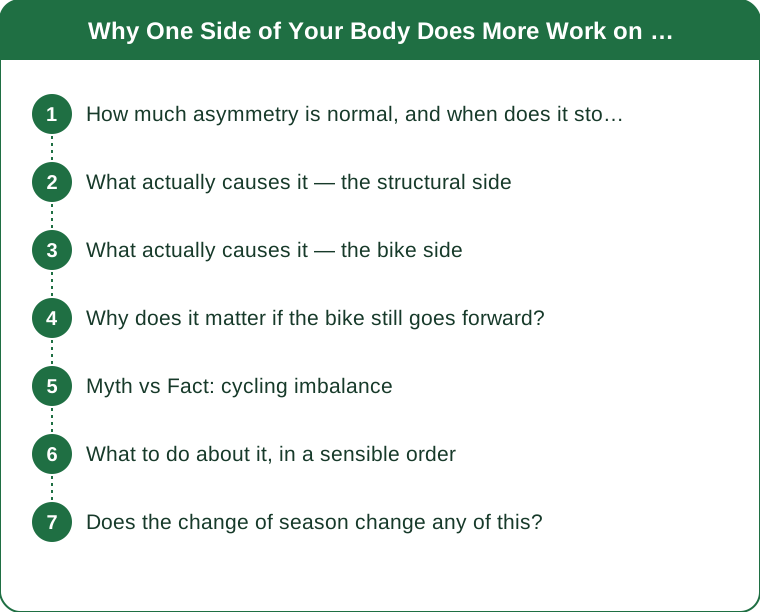
How much asymmetry is normal, and when does it stop being normal?
Some is expected. Everyone has a dominant side, everyone has slightly different limb lengths, and the nervous system develops preferences over decades of walking, standing and sitting.
Power meter data from riders across all levels typically shows left-right splits somewhere between 48/52 and 45/55. A difference in that range, stable across a ride, is generally unremarkable and does not by itself require intervention.
What makes it worth attention:
Magnitude. Splits beyond roughly 45/55 are increasingly likely to reflect something structural or a fit issue rather than natural preference. At 40/60, one leg is producing half again what the other produces, and the tissue loading difference is substantial.
Change under fatigue. This is the more informative signal, and most people never look at it. If your balance is 50/50 in the first hour and 44/56 in the third, the weaker side is not weaker — it is less enduring, which points at a different cause and a different fix. Fatigue-driven asymmetry often reflects a stabiliser that gives out rather than a prime mover that is small.
Change with intensity. Some riders are symmetrical at endurance pace and asymmetrical at threshold, or the reverse. A split that only appears when you push hard often reflects a technique or mobility limit rather than a strength one.
Symptoms. Ultimately this is the deciding factor. Asymmetry that produces no pain, no saddle discomfort, no numbness and no performance ceiling is arguably not a problem at all, whatever the number says. Asymmetry accompanied by one-sided knee pain, one-sided saddle pressure or a hip that aches after long rides is worth investigating regardless of how modest the split looks.
One important caveat about the measurements themselves: single-sided power meters estimate total power by doubling one leg’s output, which by definition cannot detect imbalance. Only genuinely dual-sided systems measure it. And even dual-sided pedal-based systems have a margin of error that is not trivial relative to the differences being discussed, so treat a single ride’s number as indicative rather than definitive. Look at trends across many rides.
Should I be trying to reach exactly 50/50?
No, and chasing it can create problems. The goal is to remove correctable causes and reduce symptoms, not to hit a number.
What actually causes it — the structural side
There are two broad families of cause: things about your body, and things about your bike. This section covers the body, because the bike is easier to change and frequently gets changed first for the wrong reason.
Leg length difference. Genuinely common — small differences of under a centimetre are widespread in the general population and often go undetected for life. On a bicycle, the effect is direct: the saddle can only be at one height, so it is either correct for the longer leg and too high for the shorter, or correct for the shorter and too low for the longer.
What that produces is a rider who rocks in the saddle, tilts the pelvis, or over-extends the ankle on one side to reach the bottom of the stroke. The compensations are usually visible from behind and almost never felt by the rider.
Importantly, the difference can be structural — actual bone length — or functional, meaning the legs are the same length but a pelvic rotation or muscular restriction makes one behave as though it is shorter. These need very different treatment, which is why this is a question for a physiotherapist rather than a tape measure at home.
Hip mobility restriction. If one hip has less internal rotation or less flexion range, that leg cannot achieve the same position at the top of the pedal stroke. The body finds a way around it — usually by dropping the opposite hip or by pushing the knee out.
Ankle range. Limited dorsiflexion on one side changes how the foot behaves through the stroke and shifts where force is applied on the pedal.
Old injury patterns. This is the most common cause in practice and the least visible. After a knee injury, an ankle sprain, or even a period of back pain, the nervous system builds a movement pattern that protects the affected side. That pattern frequently persists for years after the tissue has fully healed, because nothing ever prompted it to change. Riders often say the imbalance began with an injury they consider long resolved.
Core and gluteal control. Where one side’s hip stabilisers fatigue earlier, the pelvis loses stability under load and power drops on that side. This is the classic cause of asymmetry that appears in hour three and not hour one.
Handedness and habit. People habitually unclip on the same side, start from a stop with the same foot, and stand out of the saddle with the same leg leading. Thousands of repetitions of small preferences add up.
Can I tell which of these it is myself?
Partly. If it worsens with fatigue, suspect stability and endurance. If it is constant from the first minute, suspect structure or fit. Beyond that, a professional assessment is far more reliable than self-diagnosis.
What actually causes it — the bike side
The equipment causes are more fixable, and this is where most people should look first because the changes are cheap and reversible.
Saddle height. The single highest-leverage variable on a bicycle. Too high and the pelvis rocks side to side to reach the bottom of the stroke, which introduces asymmetry directly and also causes saddle discomfort and hamstring strain. Too low and knee loading increases.
A useful check: if your hips visibly rock when you pedal, the saddle is too high, or one leg is functionally shorter, or both. Have someone film you from behind at a steady effort — this takes two minutes and reveals more than most people expect.
Saddle fore-aft position and tilt. A saddle tilted even slightly off level, or nose-off-centre relative to the frame, produces a persistent asymmetric load on the sit bones. People adapt to it within a ride and stop noticing.
Cleat position. Cleats are set by hand and are almost never identical between shoes. Differences in fore-aft position change the effective leg length at the pedal. Differences in rotational angle force the knee to track differently on each side. Differences in lateral position change the stance width for that leg alone.
Cleat float is worth understanding here: float allows the foot to rotate slightly during the stroke. Too little float on a rider who needs it creates rotational stress at the knee; too much can reduce the stability that some riders rely on. Mismatched float between the two shoes is a genuinely common and rarely checked cause.
Crank length. Both cranks are the same length, which is correct, but if there is a real leg length difference the same crank length means the two legs work through different portions of their available range.
Shoe and insole differences. Two shoes wear differently. An insole that has compressed on one side changes the effective height by a few millimetres, which sounds trivial and is measurable at the knee across thousands of revolutions.
Reach and handlebar setup. Asymmetric upper-body position — one shoulder lower, one arm more bent — rotates the torso, which rotates the pelvis, which changes how each leg meets the pedal. Upper body asymmetry very often presents as a leg problem.
The practical order to check things:
- Saddle level and centred, checked with a spirit level rather than by eye.
- Saddle height, with video from behind to check for rocking.
- Cleat position measured, not eyeballed — mark and measure both shoes against each other.
- Insole and shoe condition compared side to side.
- Bar position and hood alignment, which are surprisingly often uneven.

Why does it matter if the bike still goes forward?
Because of repetition, and because of what the compensating side is doing.
At 85 revolutions per minute, a two-hour ride is roughly 10,000 pedal strokes per leg. Any asymmetry in loading is applied ten thousand times, with the tissues on one side absorbing consistently more than the other, in a fixed and repeated pattern with almost no variation.
This is a meaningfully different situation from running or walking, where terrain, speed changes and surface variation distribute load slightly differently on every step. Cycling’s fixed geometry is what makes small asymmetries accumulate into symptoms.
The consequences fall into three groups:
Overload on the dominant side. The leg doing more work develops tissue stress in proportion. One-sided knee pain, particularly at the front of the knee, is the most common presentation, followed by hip and lower back symptoms.
Compensation injuries on the other side. These are the ones that confuse people, because the pain appears on the side doing less work. It happens because the weaker or restricted side is not simply doing less — it is doing something different, often with a rotational component or a stabilising role it is not built for. Iliotibial band symptoms and one-sided lower back pain frequently arise this way.
Performance cost, which is smaller than people assume. A 45/55 split does not mean you are losing ten percent of your power. Total power is what it is; the question is whether the same total could be produced with less strain. For most recreational riders the performance argument is the weaker one and the injury and comfort argument is the real reason to address it.
There is also a saddle comfort dimension that is underappreciated. Asymmetric pelvic loading concentrates pressure on one side, which is a common and rarely diagnosed cause of one-sided saddle discomfort and numbness. Riders usually change saddles repeatedly before anyone suggests the load is uneven rather than the saddle being wrong.
And numbness in the hands follows the same logic. An asymmetric torso puts more weight through one arm, and the resulting nerve compression is one-sided. People treat this as a glove or bar-tape problem for years.
If you have persistent one-sided pain, numbness that does not resolve quickly after a ride, or pain that is worsening, that is worth seeing a doctor or physiotherapist about rather than adjusting your bike repeatedly. This is general information, not medical advice.
Myth vs Fact: cycling imbalance
Myth: A power meter showing 47/53 means you need to fix something. Fact: That is within the normal range for most riders. Without symptoms or a fatigue-driven trend, it is information rather than a problem.
Myth: Single-leg pedalling drills fix imbalance. Fact: They are useful for awareness and for building the smoothness of the stroke, but the evidence that they change left-right power distribution meaningfully is weak. If the cause is a mobility restriction or a fit issue, drills do not touch it.
Myth: The weaker leg needs strengthening. Fact: Sometimes, and often not. Many asymmetries are restriction problems, not strength problems — the leg can produce force but cannot get into the position required to apply it. Strengthening a restricted leg without addressing the restriction can entrench the pattern.
Myth: A professional bike fit will solve it. Fact: A good fit addresses the equipment causes, which is a large share of them, and a good fitter will refer you on when the cause is clearly in the body. It is the right first step and not a complete answer.
Myth: Imbalance means you are pedalling badly. Fact: It usually means your body is different on the two sides, which is true of essentially everyone. The bike is what is symmetrical, not you.
Myth: If it does not hurt, it will eventually. Fact: Plenty of riders ride asymmetrically for decades with no symptoms whatsoever. Intervening on an asymptomatic imbalance because a number looks untidy is how people introduce problems they did not have.
Myth: Shimming one cleat is a simple DIY fix for leg length difference. Fact: Shims can be very effective and they are also easy to get wrong, particularly since functional and structural leg length differences need opposite approaches. This one genuinely warrants assessment first.
What to do about it, in a sensible order
The principle throughout: change one thing at a time, ride on it for at least a week, and keep notes. Multiple simultaneous changes make it impossible to know what helped, and bike fit changes frequently need adaptation time before their effect is clear.
Stage one — measure before you change anything.
- Get video from directly behind at a steady effort, and from the side. Look for hip rocking, one knee tracking outward, an uneven shoulder line.
- If you have a dual-sided power meter, look at balance across several rides, and specifically compare the first third of a long ride to the last third.
- Note where any symptoms are, and whether they are one-sided.
Stage two — audit the equipment.
- Saddle level, centred, and at a height that does not produce rocking.
- Cleats measured against each other in all three axes, with matching float.
- Insoles and shoes compared for wear.
- Bar and hood alignment checked.
Stage three — address mobility, not strength, first.
- Hip flexion and internal rotation, compared side to side.
- Ankle dorsiflexion, compared side to side.
- Thoracic rotation, which affects how square your torso sits.
A restriction found here explains more asymmetries than a strength difference does, and it responds well to consistent work.
Stage four — build single-leg stability off the bike.
This is where strength work belongs, and it should be single-leg and stability-focused rather than bilateral. Split squats, single-leg deadlifts, step-ups and lateral hip work all load each side independently, which a bike cannot do. Two sessions a week is enough to matter.
Stage five — get assessed if symptoms persist, if the imbalance is large, or if you suspect a leg length difference. A physiotherapist who works with cyclists, or a bike fitter with clinical training, will get further in an hour than months of adjusting things at home.
How long before I know if a change worked?
Give any fit change a minimum of two to three rides before judging, and a mobility programme six to eight weeks. Bodies adapt slowly and the first ride after a change often feels worse purely because it is unfamiliar.
Does the change of season change any of this?
It does, in several specific ways that make late summer and early autumn a genuinely good moment to address it.
Cooler air changes how you warm up, and asymmetries are most visible cold. Restrictions that are invisible after twenty minutes in August heat are clearly present in the first half hour of a 10-degree October ride. If you want to find your asymmetry, ride the first fifteen minutes of a cool morning and pay attention — that is when the restricted side announces itself. It also means your warm-up needs to get longer as temperatures fall, because riding into a restriction while cold is how minor patterns become injuries.
Clothing changes your position. Winter layers, particularly a jacket with restricted shoulder movement, alter upper body position and therefore torso rotation. A bike fit that is perfect in a summer jersey can be subtly wrong in a winter jacket, and many riders develop a seasonal one-sided discomfort for exactly this reason.
Shoe and sock volume changes. Thicker socks and overshoes change foot position in the shoe and effectively alter cleat interface height. This is small and it is the same order of magnitude as the differences being discussed.
The indoor trainer season is coming, and it is the harsher environment for asymmetry. On a stationary trainer the bike cannot move beneath you, terrain does not vary, and you rarely stand up or change position. The loading pattern becomes even more repetitive than outdoor riding, which is why one-sided problems commonly first appear in November and December among people who ride indoors. Deliberately standing up for 30 seconds every ten minutes, and varying cadence, both help.
And the practical timing argument: the natural gap between summer goals and winter base training is the best window of the year to change your fit, work on mobility, and build single-leg strength. Doing it now means arriving at the indoor season with the pattern addressed rather than discovering it in January.
A short seasonal checklist worth running this month:
- Extend your warm-up by five to ten minutes as mornings cool.
- Check your fit in the clothing you will actually wear in October, not in a summer jersey.
- Book the fit or assessment now rather than in spring, so the adaptation happens during base training rather than during your build.
- Add two single-leg strength sessions a week as outdoor volume naturally drops.
Is winter training a bad time to change my fit?
It is arguably the best time. Lower intensity and lower volume mean more room to adapt, and any temporary discomfort costs you nothing in terms of goals.
TL;DR:
- Almost every rider is asymmetric — 48/52 to 45/55 splits are common and usually unremarkable.
- The informative signals are magnitude, change under fatigue, and symptoms, not the raw number.
- Body causes include leg length difference, hip and ankle restriction, and old injury patterns that persist long after healing.
- Bike causes include saddle height and level, cleat position and float, insole wear, and uneven bar setup — check these first because they are cheap and reversible.
- It matters because cycling repeats the same loading roughly 5,000 times an hour with no variation to distribute it.
- Fix in order: measure, audit equipment, address mobility, build single-leg stability, then get assessed.
- Change one thing at a time, and give it several rides.
- Cool mornings make restrictions visible, winter clothing alters your position, and the indoor trainer makes loading even more repetitive — so address it now, not in January.
The bike is perfectly symmetrical. You are not, and it has been quietly reporting on that for years.
Keep Reading
This article is for general informational and styling purposes only. Fit, sizing, and product availability may vary — check current details before purchasing.