Why a Saddle an Inch Off Can Show Up as Knee Pain, Not Saddle Discomfort
Quick Answer: A saddle set too low causes anterior (front) knee pain from excessive knee flexion and quad overload; a saddle set too high causes posterior (back) knee pain from overreaching at the bottom of the pedal stroke. Correct height puts a slight bend (25-35 degrees) in the knee at the bottom of the pedal stroke — checking this before assuming an injury is the fastest fix.
You’ve been icing your knee and stretching for weeks assuming overuse, when a simple saddle height check might reveal the actual cause was mechanical the entire time.

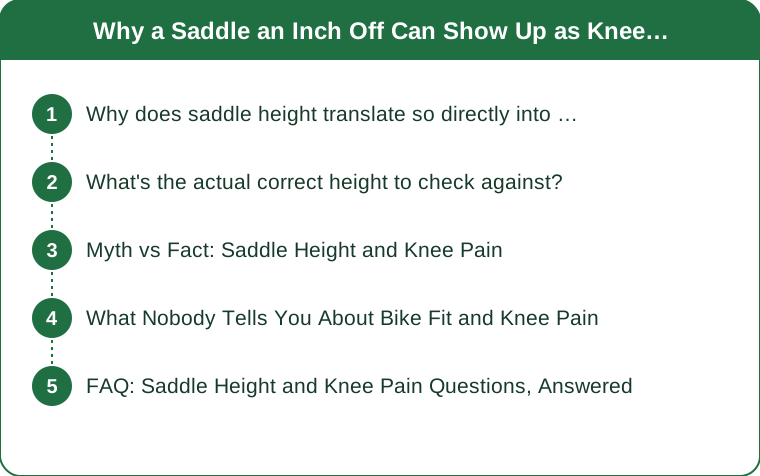
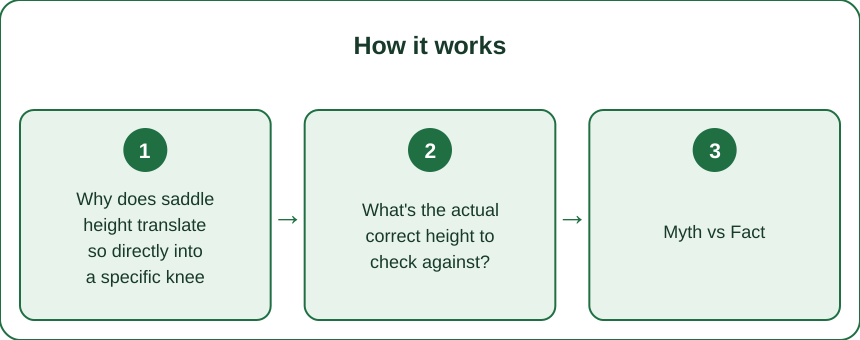
Why does saddle height translate so directly into a specific knee pain location?
At the bottom of each pedal stroke, your knee reaches its most extended position — if the saddle is too low, the knee stays more bent than optimal at that point, forcing the quadriceps and patellar tendon to work harder through a shortened range, which shows up as front-of-knee pain.
If the saddle is too high, your hip rocks and your leg overreaches to complete the stroke, straining the hamstring and the back of the knee joint — producing posterior knee pain instead. The direction of the pain is a genuinely useful diagnostic clue pointing back to which way the saddle is off.
What’s the actual correct height to check against?
At the bottom of the pedal stroke (pedal at its lowest point, heel on the pedal), your knee should have a slight bend of roughly 25-35 degrees — not fully locked out straight, but not sharply bent either. A common field method: sit on the bike with your heel on the pedal at the bottom of the stroke; your leg should be nearly straight in that position, which translates to the correct slight bend once your foot is properly clipped or positioned on the pedal normally.
Small adjustments matter — even a 1cm change in saddle height can shift the effective knee angle enough to move from comfortable to painful over a long ride.

Myth vs Fact: Saddle Height and Knee Pain
Myth: Knee pain from cycling is almost always an overuse or fitness issue. Fact: Saddle height and other bike-fit factors are among the most common, and most fixable, causes of recurring cycling knee pain.
Myth: If the saddle feels comfortable, the height is probably correct. Fact: Saddle height problems often show up as knee pain, not saddle discomfort itself — you can feel fine in the seat and still have a height-related knee issue.
Myth: A saddle height that worked for years can’t suddenly start causing problems. Fact: Flexibility, injury history, and even shoe or cleat changes can shift what height is optimal over time, even without changing the saddle itself.
What Nobody Tells You About Bike Fit and Knee Pain
Cleat position (fore-aft placement on cycling shoes) interacts with saddle height — a saddle set correctly but cleats positioned too far forward or back can still produce knee strain that looks like a height problem. Checking both together gives a more complete picture than adjusting saddle height alone.
Many cyclists gradually raise or lower their saddle over months without noticing, through small adjustments made for other reasons (like a new saddle or shoe) — periodically re-measuring against the heel-on-pedal method catches this kind of slow, unnoticed drift.
FAQ: Saddle Height and Knee Pain Questions, Answered
How much saddle height change is enough to cause knee pain?
Even 1-1.5cm off from optimal can produce noticeable knee discomfort over a long ride, especially for anterior (low-saddle) pain.
Should I see a professional bike fitter instead of adjusting myself?
A professional fit is worth it if pain persists after basic height correction, since cleat position and other factors may also need adjustment.
How quickly does knee pain improve after correcting saddle height?
Many cyclists notice improvement within a few rides, though pain from prolonged incorrect positioning may take longer to fully resolve. This is general information, not medical advice.
TL;DR:
- Low saddle height tends to cause front-of-knee pain; high saddle height tends to cause back-of-knee pain
- Correct height gives a slight 25-35 degree knee bend at the bottom of the pedal stroke
- Cleat position interacts with saddle height and is worth checking together
- Saddle height can drift unnoticed over months through small unrelated adjustments
Before treating cycling knee pain as an overuse injury, check whether an inch of saddle height is doing the damage instead.
Keep Reading
This article is for general informational and styling purposes only. Fit, sizing, and product availability may vary — check current details before purchasing.