Why Your Cycling Power Fades in the Second Hour Even When Your Legs Feel Fine
Quick Answer: Power on long rides usually fades because of four things that are not leg strength: glycogen depletion beginning around the 90-minute mark, cardiac drift raising heart rate at unchanged output, postural fatigue in the trunk and neck degrading your position, and progressive dehydration reducing plasma volume. Legs feeling fine while power drops is the signature of a fueling or thermoregulation problem, not a fitness problem. All four respond to specific changes you can make on your next ride.
If you have ever finished the second hour of a ride wondering why your numbers dropped when your legs never burned, this is the explanation — and it is the most fixable performance problem in endurance cycling.

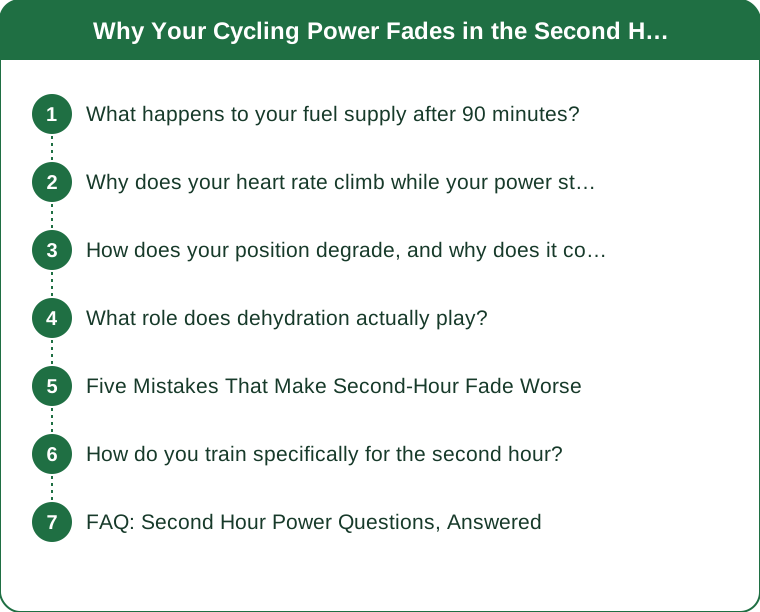
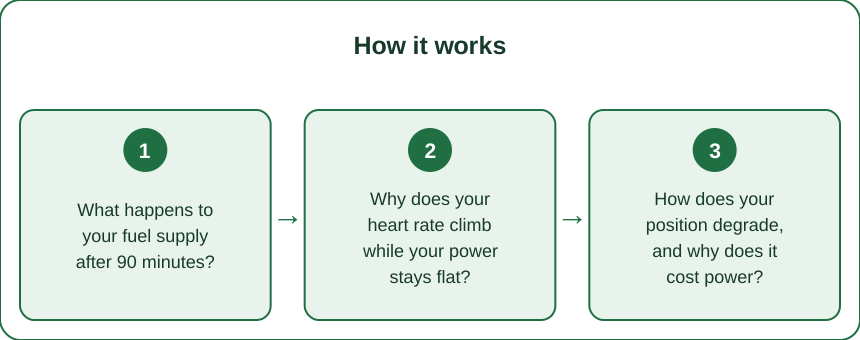
What happens to your fuel supply after 90 minutes?
It runs out, on a predictable schedule.
Your body stores roughly 400 to 500 grams of carbohydrate — about 1,600 to 2,000 calories — split between muscle glycogen and liver glycogen. At endurance pace, a moderately trained rider burns somewhere in the range of 40 to 70 grams of carbohydrate per hour. At that rate, meaningful depletion begins somewhere between 75 and 120 minutes, which lines up almost exactly with where most riders report their power starting to drift down.
The important detail is that this is not an on-off switch. Glycogen depletion is gradual, and the body compensates by shifting toward fat oxidation. Fat is an enormous fuel store, but it produces energy more slowly. You can ride all day on fat; you cannot ride hard on it. So what you experience is not a wall — it is a ceiling that quietly lowers.
That is exactly why the legs feel fine. There is no acute muscular failure, no burning, no shaking. There is simply less power available at the same perceived effort, because the fast fuel pathway has less to work with.
Liver glycogen matters separately and is often overlooked. Liver glycogen maintains blood glucose for your brain. When it drops, the symptoms are cognitive before they are muscular: reduced motivation, a fuzzy feeling, difficulty holding a wheel or a line, and a tendency to make small technical errors. Riders often describe this as losing focus and blame it on tiredness.
The fix is unglamorous and highly effective: start fueling at 30 minutes, not when you feel hungry. Aim for 30 to 60 grams of carbohydrate per hour on rides over 90 minutes, and up to 90 grams per hour on hard or long efforts if you have practiced it. Hunger is a lagging indicator by roughly an hour, and by the time it arrives you are already in deficit. Absorption is also limited — you cannot make up a deficit quickly, which is why front-loading matters more than reacting.
Why does your heart rate climb while your power stays flat?
This is cardiac drift, and it is one of the most reliably observed phenomena in endurance sport.
Over the course of a sustained effort, heart rate rises progressively even when power output is held perfectly constant. On a two-hour steady ride, a drift of 5 to 15 beats per minute is entirely normal. The mechanism is primarily a reduction in plasma volume combined with increased blood flow to the skin for cooling.
As you sweat, plasma volume falls. Lower plasma volume means less blood returning to the heart per beat, which reduces stroke volume. To maintain the same cardiac output, heart rate must rise to compensate. Simultaneously, your body diverts an increasing share of blood flow to the skin to shed heat, which competes with muscle for the same limited circulation.
The practical consequence for a rider is that the same power costs more as the ride progresses. If you pace by heart rate, you will unconsciously reduce power to hold your target zone. If you pace by power, your perceived effort will climb steadily even though the number on the screen never changes.
This becomes dramatically worse in heat and humidity. In late summer conditions, drift that would be 8 beats on a cool day can easily be 20. Humidity is the more punishing of the two variables, because it impairs sweat evaporation — you lose the fluid without getting the cooling benefit, so you get the plasma volume cost with none of the return.
What helps: start the ride properly hydrated rather than trying to catch up, drink 500 to 750ml per hour in warm conditions, include sodium at roughly 500 to 1,000mg per liter, and use shade and airflow deliberately. Riding into a headwind is cooler than riding with a tailwind at the same speed, which is worth remembering when planning the direction of a long summer loop.
How does your position degrade, and why does it cost power?
Slowly, invisibly, and expensively.
Holding a cycling position is an endurance task for your trunk, neck, shoulders, and hip flexors. None of these muscles produce power, but all of them determine whether the muscles that do can work efficiently. As they fatigue, your pelvis rotates, your lower back rounds, and your hip angle closes.
A closed hip angle is the specific problem. When the pelvis rotates backward, the effective angle between your torso and thigh at the top of the pedal stroke narrows. That reduces the range over which your glutes can contribute and shifts more of the work to the quadriceps. The glutes are your largest and most fatigue-resistant power producer, so losing access to them is a direct power loss with no corresponding sensation of leg failure.
Neck and shoulder fatigue produces a second-order problem. As the neck tires, riders drop their head, which changes their sight line, which causes them to shift position on the saddle, which changes their hip angle again. It compounds.
The signs are visible on a ride: sitting up more often, moving back on the saddle, shrugging the shoulders, gripping the bars harder. Riders read these as discomfort. They are actually the leading edge of a power decline.
The fixes are partly on the bike and partly off. On the bike: stand for 15 to 20 seconds every 10 to 15 minutes, deliberately, before you feel the need. This resets pelvic position, restores blood flow to the seat area, and dramatically slows positional decay. Change hand position regularly for the same reason.
Off the bike: trunk endurance work two to three times a week — planks, side planks, bird dogs, and hip hinge patterns — in sets of 30 to 60 seconds rather than heavy short sets. Endurance is the quality that matters here, not maximum strength. Riders who add this consistently often report their second-hour power improving without any change to their leg training at all.

What role does dehydration actually play?
A larger one than most riders account for, and it starts earlier than they think.
A fluid loss of about 2 percent of body weight is the commonly cited threshold where endurance performance measurably declines. For a 65kg rider that is 1.3 litres — achievable within 90 minutes on a warm day at typical sweat rates of 0.8 to 1.5 litres per hour.
The mechanism links directly back to cardiac drift. Less fluid means less plasma, less stroke volume, higher heart rate at the same output, and reduced capacity to move heat to the skin. Dehydration and thermoregulation are not two problems — they are one problem observed from two angles.
Sodium deserves separate attention. Sweat contains sodium at concentrations that vary widely between individuals, from roughly 200 to over 1,500mg per litre. Riders on the high end who drink plain water can dilute their blood sodium over long rides, which produces symptoms — headache, nausea, sluggishness, muscle cramping — that look like dehydration and get treated with more plain water, making it worse.
A practical approach: weigh yourself before and after a two-hour ride in typical conditions, without changing your usual drinking. Every kilogram lost represents roughly a litre of fluid deficit. That single measurement tells you your personal sweat rate more accurately than any calculator.
Also worth knowing: you cannot absorb fluid indefinitely fast. Gastric emptying limits practical intake to around 750ml to 1 litre per hour for most people, and higher intakes tend to sit in the stomach and cause discomfort. This means that on hot rides, you will finish in deficit no matter what you do. The goal is to manage the size of the deficit, not eliminate it, and to start the ride topped up rather than trying to win it back mid-ride.
Five Mistakes That Make Second-Hour Fade Worse
Starting too hard because you feel good. The first 20 minutes of a ride feel easy because you are fully fueled, fully hydrated, and thermally comfortable. Riding those minutes 20 watts above your intended pace accelerates glycogen use disproportionately, and you pay for it in hour two. Deliberately hold back for the first 15 minutes.
Fueling reactively. Waiting for hunger, low energy, or a drop in the numbers means you are chasing a deficit you cannot close. Set a timer for every 20 minutes and eat on it whether you want to or not.
Training long rides fasted, always. Fasted riding has legitimate uses for building fat oxidation, but doing it as the default means never practicing gut tolerance for fueling. Race-day fueling is a trained skill — the gut adapts to carbohydrate intake with repeated exposure, and a gut that has never seen 60g per hour will reject it when it matters.
Ignoring the neck and trunk. Riders will do leg-specific strength work for years without ever addressing the postural chain that determines whether that leg strength can be applied after 90 minutes. It is the single most neglected input in amateur endurance cycling.
Blaming fitness. Second-hour fade with fresh-feeling legs is almost never a fitness ceiling. Fitness limits show up as legs that hurt. Fuel, heat, and position limits show up as power that quietly disappears while the legs feel unremarkable. Correctly identifying which one you have determines whether the next three months of training are useful or wasted.
How do you train specifically for the second hour?
By making the second hour the point of the session, rather than the tail of it.
Back-half progression rides. Ride 2 to 2.5 hours where the second half is deliberately at a higher average power than the first, by roughly 5 to 10 percent. This teaches pacing discipline and forces the systems that normally fail in hour two to work under load rather than coast.
Long ride with efforts placed late. Instead of doing intervals in the first hour when you are fresh, place 3 to 4 blocks of 8 to 10 minutes at threshold in the last 45 minutes of a long ride. The physiological stimulus is different and considerably more specific to what actually limits you.
Heat exposure, done carefully. Repeated exposure to riding in heat produces genuine adaptations within 7 to 14 days: increased plasma volume, earlier sweat onset, and lower sweat sodium concentration. All three directly reduce cardiac drift. Late summer is the natural window for this, and the adaptations partially carry over to cool-weather performance.
Fueling practice as a session goal. Pick a long ride where the only objective is consuming 80 to 90 grams of carbohydrate per hour without gut distress. Most riders cannot do this on the first attempt and can do it comfortably after four to six sessions.
Trunk endurance twice weekly, off the bike. Six to eight minutes total of planks, side planks, dead bugs, and single-leg hinge work. It is a small time investment against a problem that costs a measurable share of your second-hour power.
Run all five over an eight-week block and the typical outcome is not a higher peak power — it is a much smaller gap between hour one and hour two, which for almost every rider matters more.
This is general information, not medical advice. Persistent unexplained fatigue, dizziness, or chest symptoms during exercise should be evaluated by a clinician rather than trained through.
FAQ: Second Hour Power Questions, Answered
How do I tell fueling fade from fitness fade?
Fitness fade comes with leg-specific sensations — burning, heaviness, a clear muscular limit. Fueling fade comes with normal-feeling legs, reduced motivation, and a general flatness. If you can sprint hard for 10 seconds but cannot hold your normal steady power, it is fuel, not fitness.
Does a bigger breakfast solve it?
Partially. A carbohydrate-rich meal 2 to 3 hours before topping up liver glycogen genuinely helps, but it cannot cover a three-hour ride. Pre-ride fueling and in-ride fueling are complementary, not substitutable.
Is cardiac drift a sign of poor fitness?
Less drift generally correlates with better aerobic fitness and better heat acclimation, but some drift is universal and unavoidable. A useful benchmark is the ratio of drift over a steady 90-minute ride — under 5 percent is well-adapted, over 10 percent suggests fueling, hydration, or heat acclimation has room to improve.
Should I use heart rate or power to pace long rides?
Power for the first hour, perceived effort for the rest, with heart rate as a monitoring signal rather than a target. Pacing strictly by heart rate late in a long ride guarantees you ride slower than necessary, because the drift is not telling you that you are working harder — it is telling you that you are hotter and drier.
TL;DR:
- Second-hour fade with fresh legs is a fuel, heat, hydration, or position problem — not a fitness problem.
- Glycogen depletion begins around 90 minutes; start fueling at 30 minutes and hold 30 to 60g of carbohydrate per hour.
- Cardiac drift and dehydration are the same problem seen twice; weigh yourself before and after a ride to learn your sweat rate.
- Stand for 15 to 20 seconds every 10 to 15 minutes to reset your hip angle before position decay costs you power.
- Train the second hour on purpose: back-loaded efforts, heat exposure, and fueling practice.
On your next long ride, set a 20-minute fueling timer and stand up every 12 minutes. Compare your second-hour average to your last three rides. For most riders that alone closes a meaningful part of the gap.
This is general information, not medical advice.
Keep Reading
This article is for general informational and styling purposes only. Fit, sizing, and product availability may vary — check current details before purchasing.