Why Your Saddle Feels Perfect for an Hour and Unbearable at Ninety Minutes
Quick Answer: Discomfort that appears only after 60 to 90 minutes is almost never about saddle width or padding. It is about sustained pressure reducing blood flow to soft tissue, combined with position drift as you fatigue - you rotate forward onto soft tissue, stop shifting position, and the same contact points bear load continuously. The three highest-value changes are standing for ten seconds every ten minutes, checking saddle tilt to within one degree, and getting your sit bones measured rather than guessing at width.
The first hour is completely fine. Somewhere in the second, it becomes the only thing you can think about.
That pattern is diagnostic, and it points away from most of what saddle marketing is about.

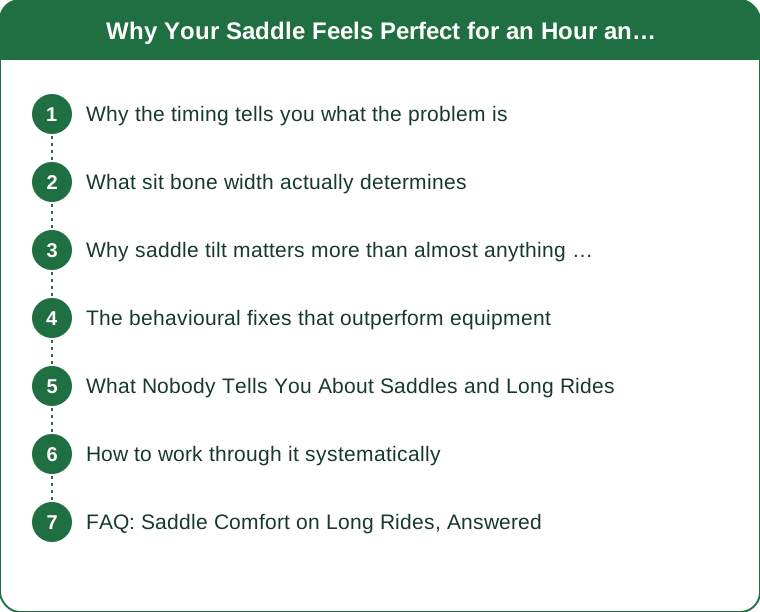
Why the timing tells you what the problem is
A genuinely mismatched saddle produces discomfort quickly. Wrong width, a nose that is too high, or a shape that does not suit your anatomy makes itself known within the first fifteen to twenty minutes. If your first hour is comfortable, those gross mismatches are largely ruled out.
What changes after an hour is tissue perfusion rather than fit. Sustained pressure on soft tissue restricts blood flow. Restricted blood flow produces numbness first and pain second, and the timeline for that on a bike is typically somewhere in the 45 to 90 minute range depending on how much pressure and how little movement.
Position drift is the second factor and it is underrated. In the first hour you shift constantly without noticing - forward on climbs, back on descents, standing over rough sections. As you tire, you stop. The same tissue then takes continuous load in a fixed position, which is precisely the condition that produces the problem.
Fatigue also changes your posture on the bike. Core endurance fades, the pelvis rotates forward, and weight transfers from the sit bones - which are built to carry load - onto soft tissue, which is not. The saddle did not change; the way you are sitting on it did.
Swelling contributes toward the end of long rides. Soft tissue under sustained pressure retains fluid, which increases pressure further in a self-reinforcing loop. This is why the last thirty minutes of a long ride are disproportionately worse than the ninety before them.
And chamois performance degrades with time. Padding compresses, moisture accumulates, and friction increases as fabric becomes saturated. A chamois that was excellent at minute thirty is a different product at minute one hundred and twenty.
What sit bone width actually determines
Sit bones - the ischial tuberosities - are the structures designed to bear seated weight. The whole purpose of saddle width selection is to make sure they land on the supportive part of the saddle rather than off the edges.
Too narrow, and your sit bones straddle the sides. Weight then transfers to the soft tissue between them, which is not built for load and which responds to sustained pressure exactly as described above. This is the single most common cause of long-ride discomfort in riders whose short rides are fine.
Too wide is a real problem too, producing chafing at the inner thigh where the saddle edges catch with every pedal stroke. It usually announces itself sooner than too-narrow does.
Sit bone width varies enormously between individuals and does not track body size or gender reliably enough to guess from. Two riders of identical height can differ by 30mm or more.
Measuring is genuinely easy. Most good bike shops do it free with a gel or memory-foam pad. At home, sitting on corrugated cardboard on a hard chair, leaning slightly forward, leaves two clear impressions you can measure between the centres.
Saddle width is typically sit bone width plus roughly 20 to 30mm, varying with riding position - the more forward and aggressive your position, the narrower the effective contact and the narrower the saddle tends to be.
And a cutout or channel addresses a different variable entirely. It relieves pressure on the perineal soft tissue in the middle, which is why many riders need both correct width and a relief channel rather than one or the other.
Why saddle tilt matters more than almost anything else
One degree of tilt changes pressure distribution substantially. This is not a metaphor - a nose-up tilt of a degree or two moves a meaningful proportion of your weight onto soft tissue at the front of the saddle.
Nose-up is the most common error and often happens by accident when a saddle is installed, or gradually as a clamp slips over months of riding.
Slightly nose-down helps many riders, particularly women and particularly in a more forward position, because it relieves anterior soft tissue pressure. Too far down transfers weight to your hands and produces a different problem, so this is a small adjustment rather than a large one.
Check it with a level, not by eye. Phone spirit level apps are accurate enough for this, and eye estimates are consistently wrong because the saddle’s shape misleads you about its actual plane.
Adjust in half-degree increments and ride at least an hour between changes, because the whole point is that the problem only appears after an hour. Making three changes in one ride tells you nothing.
Saddle height and setback interact with tilt. A saddle too high causes rocking, which produces friction rather than pressure pain; too far back rotates you forward onto the nose. If tilt adjustments are not resolving it, the other two are the next places to look.
And write down every change. People adjust, forget, adjust back, and lose weeks. Two lines in a note - date, what changed, what happened - saves an entire season of guessing.

The behavioural fixes that outperform equipment
Stand for ten seconds every ten minutes. This is the single most effective intervention available and it costs nothing. It restores blood flow before the tissue has been compressed long enough to complain, and riders who do it consistently report a different experience on long rides.
Set a reminder rather than relying on memory, because the entire problem is that you stop moving as you fatigue - which is exactly when you will forget to stand.
Shift position deliberately every few minutes. Slightly forward, slightly back, hands to a different position. Changing the contact points is what keeps any single point from accumulating too much load.
Get out of the saddle on every climb, even briefly. Climbs are natural opportunities that fatigued riders skip precisely when they need them most.
Use chamois cream on rides over about two hours. Friction and moisture are separate contributors to the problem, and cream addresses both. Apply generously to the chamois rather than sparingly.
Strengthen the core off the bike. Position drift is largely a trunk endurance issue, so planks, dead bugs and back extension work translate directly to holding position at hour two.
And build long-ride volume gradually. Soft tissue adapts to sustained pressure with progressive exposure, and jumping from an hour to three hours produces problems that the same three hours would not cause after six weeks of building.
What Nobody Tells You About Saddles and Long Rides
More padding usually makes long rides worse, not better. Soft padding compresses under the sit bones until they sink through it, at which point the padding is pressing up on the soft tissue between them. This is why racing saddles are firm and why the most comfortable saddle in the shop is often the worst one at hour three.
Gel covers are the same trap with a bow on it. They feel better for the first twenty minutes and worse for every minute after that.
Numbness is a signal to act on, not to tolerate. Persistent perineal numbness indicates significant pressure on nerves and blood vessels, and it warrants a position change and, if it persists, a medical conversation. This is general information, not medical advice.
Underwear beneath a chamois defeats the chamois entirely. The chamois is designed for direct contact; a seam layer between it and you is a friction generator in exactly the wrong place.
Your saddle needs replacing more often than you think. Foam and shell both fatigue, and a saddle that has done several thousand miles is a different shape than the one you bought, which is why a comfortable setup can slowly become uncomfortable with nothing appearing to change.
Bib shorts genuinely outperform waist shorts on long rides, because a waistband digging in at hour two changes how you sit, which changes where the pressure goes.
And the saddle that works for a friend tells you nothing. Sit bone width, pelvic rotation, flexibility and riding position all differ, which is why saddle recommendations are among the least transferable advice in cycling and why demo programmes exist.
How to work through it systematically
Change one thing at a time. The temptation with an uncomfortable saddle is to change saddle, tilt, height and shorts simultaneously, after which you know nothing about which change mattered.
Start with tilt, because it is free and it is the most common error. Level it accurately, ride two long rides, then try half a degree nose-down and ride two more.
Then measure sit bones and check your saddle width against them. If you are more than about 10mm off, that is likely your answer and no amount of tilt adjustment will substitute.
Then check saddle height and setback, ideally with someone watching you pedal or with a video from behind. Rocking hips indicate a saddle too high, and that produces friction pain rather than pressure pain - a distinction worth making because the fixes differ.
Then consider a cutout or channel if pressure is central and anterior rather than on the sit bones.
Then, and only then, consider a different saddle, using a demo programme if one is available. Buying saddles blind is expensive and the failure rate is high.
Book a professional bike fit if you have worked through this without resolution. A fit costs meaningfully less than three wrong saddles, and long-ride discomfort that survives all of the above is usually a position problem rather than a component problem.
And log each stage with what changed and what happened at ninety minutes, because the entire diagnostic signal here is time-dependent and memory across weeks is unreliable.
FAQ: Saddle Comfort on Long Rides, Answered
How long should it take to break in a new saddle?
The saddle does not break in much; you adapt to it. Give a new saddle three to four rides including at least one long one before judging, but genuine pain in the first twenty minutes will not improve with time.
Is a women’s specific saddle necessary?
Sometimes, and it is a distribution rather than a rule. Women on average have wider sit bones and often benefit from a relief channel, but individual measurement beats the category label every time.
Should the saddle be perfectly level?
Level is the right starting point. Many riders end up between level and about two degrees nose-down, and adjustment should be in half-degree steps with a long ride between each.
Why does it hurt more on the trainer than outdoors?
Because you never coast, never stand and never shift position indoors. The bike is not moving under you, so the constant micro-adjustments that happen outdoors disappear entirely. Deliberate standing breaks matter even more on a trainer.
Is numbness normal?
Brief numbness that resolves when you stand is common. Persistent numbness, or numbness that lasts after the ride, indicates meaningful nerve and vascular pressure and warrants a position review and medical advice. This is general information, not medical advice.
Do I need a bike fit or a new saddle first?
Work through tilt, sit bone width and height yourself first, since those are free or cheap. If discomfort survives all three, a fit will find the answer faster and more cheaply than buying saddles.
Does riding more often actually help?
Yes - tissue adapts to sustained pressure with progressive, regular exposure. Three rides a week of moderate length builds tolerance for long rides better than one long ride a week does.
TL;DR:
- Discomfort that only appears after an hour points to pressure duration and position drift, not saddle width or padding.
- Stand for ten seconds every ten minutes - the highest-value change available and it costs nothing.
- Check saddle tilt with a level; one degree changes pressure distribution substantially, and nose-up is the common error.
- Get sit bones measured rather than guessed; too narrow transfers load to soft tissue that cannot carry it.
- More padding usually makes long rides worse, because the sit bones sink through it onto the tissue between them.
- Change one variable at a time and log it, since the signal only appears at ninety minutes.
Persistent numbness is a reason to change position and seek advice, not something to ride through. This is general information, not medical advice.
Keep Reading
This article is for general informational and styling purposes only. Fit, sizing, and product availability may vary — check current details before purchasing.